

FLASHPOINT: TREASURY ON THE MOVE – RELEASES INFORMATION ON
SAVER’S MATCH, ROLLOVER GUIDANCE, AND TRUMP ACCOUNTS
by: Alison J. Cohen, Esq. and Ilene H. Ferenczy, Esq.
Trying to beat the clock for the end of the federal government’s fiscal year (which is coming up fast on September 30), the Treasury and Internal Revenue Service (“IRS”) released several pieces of guidance, including Notice 2026-48 (Saver’s Match), Notice 2026-49 (relating to new rollover procedures), as well as proposed regulations for employer contributions to a 530A account (a.k.a., a Trump account). Of course, what we really wanted this summer were the very late final regulations on long-term part-time employees, mandatory automatic enrollment, and our favorite – the update to the Employee Plans Compliance Resolution System (“EPCRS”). But, we’ll take what we can get.
Saver’s Match: Is This A Lot of Effort and Confusion for Very Little Payoff?
Notice 2026-48 provides a preview of its intended proposed regulation for the Saver’s Match contributions. These contributions, enacted under Section 103 of the SECURE 2.0 Act of 2022 (“S2.0”) will take effect in relation to taxpayer deferrals and IRA contributions made in 2027, with the first matching contributions to be deposited to plans in 2028. To make a long story short, certain low- and moderate-income individuals may receive up to $1,000 as a match paid by the Treasury, provided they make qualified retirement savings contributions.
Based on the original request for comments issued in 2024, the IRS developed Notice 2026-48 in the form of a Q&A, which was supposed to make things clearer in anticipation of regulations. To quote the great Maxwell Smart: “Missed it by that much.” In fact, the twists and turns of this guidance are enough to make your head spin. (To paraphrase another piece of American entertainment culture: Fasten your seatbelts. It’s going to be a bumpy FlashPoint.)
The Saver’s Match – A Quick Intro
The concept of the Saver’s Match is that, if an individual saves in either a qualified plan or an individual retirement account (“IRA”), and his or her “modified” adjusted gross income (“MAGI”) for the year is below a threshold, the U.S. Treasury will fund a match of 50% of up to $2,000 of savings (i.e., for a maximum match of $1,000). As an individual’s MAGI exceeds the threshold, the available Saver’s Match phases out, and is unavailable if the MAGI gets too high. So, this is intended to be a vehicle for individuals with relatively low MAGI. For this purpose, a taxpayer’s MAGI is the sum of his or her adjusted gross income (Form 1040, line 11a) plus pretax salary deferrals or other pretax amounts contributed to retirement plans, plus deductible IRA contributions. In addition, foreign source income and income from U.S. possessions excluded from gross income under Code sections 911, 931, and 933 are added back to determine MAGI.
Who Can Get the Saver’s Match?
To be eligible for a Saver’s Match, an individual must be age 18 by the end of the year, not claimed as a dependent by anyone, not a full-time student, and not a nonresident alien (unless the individual made an election under Code section 6013 to be treated as a U.S. resident for the tax year).
How Much is the Saver’s Match?
The full 50% Saver’s Match is paid only for taxpayers whose MAGI falls at or below the “Applicable Dollar Amount” threshold shown on this chart, based on the taxpayer’s filing status for the year:
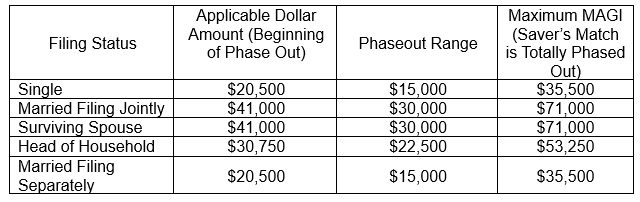
If the taxpayer’s MAGI exceeds the Applicable Dollar Amount, the Saver’s Match begins to phase out – that is, the percentage of the match is decreased below 50%. At the Maximum MAGI shown in the last column above, no Saver’s Match is payable. Taxpayers need to apply the following formula to find out what percentage match they will receive:

For married couples who file taxes jointly, the MAGI is the total of both their adjusted gross incomes, with the above listed modifications. However, once the Saver’s Match percentage is determined, it applies separately to each spouse’s eligible retirement plan savings. For example, if Minnie and Mickey are married and have joint MAGI of $41,000, the Treasury will match each of their savings at 50% up to $1,000.
How likely is it that the average person can apply the above formula to calculate the expected matching contribution? The Notice provides the following “helpful” example (which the IRS apparently believes is easily understood):
Taxpayer A is a single filer who made a $1,500 contribution to Taxpayer A’s traditional IRA in 2027. Taxpayer A’s MAGI for 2027 is $30,000. Taxpayer A is eligible to receive a Saver’s Match contribution and makes a claim for a Saver’s Match contribution for 2027. Taxpayer A’s Saver’s Match contribution for 2027 is $285, calculated as follows:
-
-
- Percentage point reduction = 50 percentage points x (($30,000 – $20,500) ÷ $15,000) = 31.6667
- Percentage point reduction rounded down to the nearest percentage point = 31
- 50% – 31 percentage points = 19%
- $1,500 x 19% = $285
-
One must wonder whether getting $285 is worth the effort of doing the calculation, much less taking the other steps necessary to claim the Saver’s Match.
What Contributions Are Matched?
This is honestly the easiest part of the whole Saver’s Match process. Assuming the taxpayer can qualify (and actually understands that they qualify) to receive the Saver’s Match, they must contribute to a qualified retirement plan, 403(b) plan, 457(b) governmental plan, or IRA. The eligible contributions include pretax amounts, Roth amounts, and after-tax voluntary contributions. Only contributions up to $2,000 will be matched.
How is the Saver’s Match Claimed?
The taxpayer will claim a Saver’s Match by filing Form 8880-A with his or her tax return. This form will enable the taxpayer to demonstrate his or her eligibility for the match, and to provide information as to the account to which the Saver’s Match should be deposited.
Where is the Saver’s Match Deposited?
This is one of the areas where this Notice will make your head spin. The account to which the taxpayer’s contributions are made is not necessarily where the Saver’s Match will be deposited. The only accounts to which the Treasury may directly contribute a Saver’s Match deposit (called “Applicable Retirement Savings Vehicles”) are those that are:
- Pretax (not Roth) accounts in a 401(k) plan, 403(b) plan, a governmental 457(b) plan, or an IRA
- For the benefit of the taxpayer (who must be an eligible individual)
- Willing to accept the Saver’s Match
- Designated by the taxpayer for receipt
The taxpayer must designate an Applicable Retirement Savings Vehicle as the recipient plan (although see the Roth exception below). If the designated account is an IRA, the Treasury will then deposit the Saver’s Match directly into that account.
The taxpayer may instead designate a Roth IRA to receive the Saver’s Match, even though it is not an Applicable Retirement Savings Vehicle. However, the Treasury cannot make a direct payment of the Saver’s Match to a Roth account. Therefore, if the Roth account is chosen, the Treasury will arrange for its deposit to be made to a conduit pretax IRA that it creates for the taxpayer, and then immediately rolled over in a Roth conversion transaction to the designated Roth account. (Excuse us if we are a little cynical about how smoothly this process will go.)
If the recipient plan is a qualified plan (which is an Applicable Retirement Savings Vehicle), the process is more complex, and the Treasury has not decided definitively as to how it would work. The Notice proposes three options for the process. We will report as to how this would work once the Treasury makes a decision. (The Treasury specifically requested comments on this issue.)
If the expected Saver’s Match is greater than zero, but less than $100, the taxpayer may instead elect for it to be treated as a refundable income tax credit, rather than having it deposited into a plan.
How is the Saver’s Match Treated by the Recipient Plan?
Once funded, the Saver’s Match is treated in the recipient plan as an elective deferral or IRA contribution, but it is not subject to the Code section 402(g) limit or the section 415 limit. The Saver’s Match is disregarded for nondiscrimination testing and is not considered for top-heavy purposes. (Because that’s not going to be confusing at all.) Furthermore, one more, somewhat annoying, requirement in the Code applies only to the account to which the Treasury makes the Saver’s Match (and not to accounts that accept a rollover of the Saver’s Match). The Saver’s Match funds cannot be distributed for hardship (or, in 457(b) plans, for unforeseeable emergencies). Therefore, plans that accept the Saver’s Match directly from the Treasury cannot commingle the Saver’s Match with accounts that can be distributed for hardship (such as regular deferrals). However, a plan containing the Saver’s Match that did not receive such match directly from the Treasury, but in a rollover (even one arranged by the Treasury at the time the Saver’s Match was deposited) does not need to limit distributions in this fashion and can freely commingle the rolled over Saver’s Match with the salary deferrals.
But, Wait! There’s More (Reductions)!
Distributions Taken During the “Testing Period” Reduce Contributions to Be Matched
The contribution eligible to be matched is reduced by distributions taken by the taxpayer or his/her spouse during the so-called Testing Period. The Testing Period includes the taxable year for which the Saver’s Match will be claimed (the “Saver’s Match year”), the two years before the Saver’s March year, and the year following the Saver’s Match year, up to the tax return due date for the Saver’s Match Year (including extensions). The graphic below might make the Testing Period easier to understand:

So, for example, if a taxpayer is claiming a Saver’s Match for calendar year 2028, the Testing Period would run from 1/1/2026 through 10/15/2029. Any distribution taken during that period would reduce the contributions eligible for a Saver’s Match on a dollar-for-dollar basis.
Example: Donald makes contributions to an Applicable Retirement Savings Vehicle in the amount of $2,000 during 2028. However, in March of 2029, Donald takes a distribution of $500. The amount of contributions eligible to be matched by the Saver’s Match is reduced to $1,500. The result would be the same if the $500 distribution was taken anytime between January 1, 2026, and October 15, 2029.
Distributions that reduce the contributions eligible for the Saver’s Match do not include distributions of excess deferrals, excess contributions, excess aggregate contributions, and ESOP dividend distributions, nor do they include participant loans treated as distributed under Code section 72(p), rollovers, or amounts contributed but then removed from an IRA before the taxpayer’s tax return due date (including extensions).
Saver’s Match Recovery Taxes
There is a second distribution situation which may produce an extra tax in any year following the contribution of a Saver’s Match. This is to reduce the in-and-out Saver’s Match hokey-pokey that may occur. Here’s the set up: a taxpayer takes a pre-age 59½ distribution from an Applicable Retirement Savings Vehicle of an amount that reduces the balance in the vehicle below the total Saver’s Match contributions it has received. In that case, an additional tax (a “Recovery Tax”) will be levied equal to the difference between the total Saver’s Matches historically received and the current account balance of the account, minus any 10% premature distribution tax under Code section 72(t) applied to the distribution during that year.
Example: Daisy, age 39, got a $1,000 Saver’s Match contributed to her IRA in 2029 in relation to her $2,000 deferral to the account. After receipt of the Saver’s Match, the balance in the account is $3,000. (Assume for ease that Daisy did not earn any interest on the account at that point.)
Two years later, in 2031, Daisy takes a distribution of $1,500. The ending balance in the account is $1,500, which is more than the Saver’s Match that was contributed, so no Recovery Tax applies.
The following year, in 2032, Daisy takes another $1,000 out of the account. Now, the balance in the account is $500. As that is less than the $1,000 Saver’s Match that was contributed, Daisy will be required to pay a Recovery Tax equal to $500, minus the 10% tax under Section 72(t) on the entire distribution (not just the recovery amount). In this case, that tax is 10% of the $1,000 that Daisy took out of the plan, or $100, reducing the Recovery Tax to $500 – $100, or $400.
A couple of interesting questions arise. First, the Recovery Tax applies only if the distribution is taken from an Applicable Retirement Savings Vehicle. If the Saver’s Match was rolled over – either by the Treasury or by the taxpayer – to an account that is not the Applicable Retirement Savings Vehicle, it does not appear that the Recovery Tax applies.
Second, who is responsible for keeping track of the historic Saver’s Match contributions made to the Applicable Retirement Savings Vehicle, particularly if it is a qualified retirement plan? Will a plan sponsor need to report that the Recovery Tax applies when it files the Form 1099R for the participant?
Finally, it appears that the Recovery Tax applies, regardless of how much time has passed between the receipt of the Saver’s Match and the distribution. So, a taxpayer could receive a Saver’s Match at age 25 and take a distribution at age 58 and still be responsible for the Recovery Tax.
Reporting, Transmission of Information, and the Rest
The Notice acknowledges that there are a lot of moving parts, and that communication among all the parties is critical. The taxpayer needs to know whether the plan to which he or she contributes will accept the Saver’s Match. If it does, an IRA to which contributions are made (and possibly a qualified plan – still to be determined) apparently needs to register with the IRS and get a number identifying it. If the plan to which the contributions are made cannot accept the direct transfer from the Treasury, then another account must be identified. Distributions must be identified properly on Forms 1099R and taxes – normal or extraordinary – must be paid. And, all this for an annual contribution that will not exceed $1,000.
Final Comments
The Saver’s Match is a fine attempt at helping lower income people save for retirement. The Notice makes a plea to plan sponsors and IRA issuers to assist in this erstwhile effort. However, the bells and whistles attached to the process can’t help but make one wonder how practical it is. How many employers want to get involved in this circuitous process? How many taxpayers will do what is necessary to find a valid recipient account, and then do the necessary calculations and tax form filings to claim the Saver’s Match? What is the possibility that the Treasury will be able to accurately make the deposits in the right amounts and for the right people?
The Notice is a pre-proposal; proposed regulations will follow. So this analysis is at its very beginning stages, even though contributions that will qualify for a Saver’s Match will start being made in four months.
The IRS welcomes comments, which must be made by October 5, 2026. We anticipate that there will be several critical comments submitted.
Rollover Guidance in Notice 2026-49
S2.0 Section 324 provided that the Secretary of the Treasury must develop and issue guidance (with all the necessary accoutrements) to “simplify” the rollover process and expedite the completion of rollovers. Notice 2026-49 (the “Proposal”) outlines what the IRS intends that the ultimate guidance will provide to achieve these lofty goals.
The Proposal reflects the recognition by Congress, the IRS, and the Government Accountability Office (“GAO”), which reviewed rollover processes both in 2013 and 2024, that participants wanting to have a rollover must go through a labyrinthine process that varies from plan to plan and fundholder to fundholder. S2.0 Section 324 and the Proposal look to standardize all aspects of the process and reduce the participant’s role, forcing the distributing and recipient plans to communicate and take the laboring oar in effecting the rollover. In addition, the various governmental entities recognize that the process that currently exists to verify the legitimacy of the rollover is fraught with difficulties and is not commonly followed. (For example, the current rules require that the recipient plan take reasonable steps to verify that the amount it is accepting as a rollover is a valid rollover, while simultaneously curbing the extent to which the verification process can intrude on the participant’s ability to effect the rollover.) The new process will also favor electronic transmission of data and funds as a means of making the transaction more secure.
The Proposal doesn’t change what constitutes an Eligible Rollover Distribution under Code sections 402 and 408 or any of the basic requirements for rollovers found in Treasury Regulation section 1.401(a)(31)-1.
What the Proposal does do is set up a four-step process for making a rollover happen, with each step involving a new form, all intended to make the rollover process more efficient. These new procedures and forms are designed to:
- Protect participants’ personal identifying information (PII) by using encrypted data transfers
and a new rollover identification number (RIN); - Require coordination and communication between the plans to facilitate the rollover process
and to minimize the participant’s burden in the rollover process; - Standardize the data, terms, process, and forms used for rollovers;
- Require plans to verify the accuracy of information with respect to the rollover and the legitimacy of
the rollover; and - Require electronic communications and rollover transfers to the maximum extent possible.
The conversion to electronic communications and fund transfers is basic to these rules: if the Proposal is finalized, it would disallow plans from issuing issue paper checks to participants. The new rules would allow paper checks to be sent from the distributing plan to the service provider of the receiving plan.
Here is a summary of the proposed process:
IRS Form 1: Rollover Request Authorization: The participant prepares and securely transmits this form to the plan that is to accept the rollover (the “Receiving Plan”). (We can’t wait to see how the IRS can force participants to learn how to securely transmit the Form instead of using email or other nonsecure methods.) This form contains information about the participant, the distributing plan, the amount to be rolled over, and the participant’s signed authorization for the plans to communicate and effect the rollover. This is the only form that the participant will touch.
IRS Form 2: Receiving Plan’s Request to Distributing Plan: Upon receipt of Form 1, the Receiving Plan creates and assigns a Rollover Identification Number (“RIN”), which is a unique number for this particular participant and rollover transaction. The Receiving Plan then uses Form 1 and Form 2 to advise the Distributing Plan of the requested rollover, and to offer means of secure information and funds transfers that it can accommodate. Last, the Form 2 should provide the Distributing Plan with a contact that can respond to questions.
IRS Form 3: Distributing Plan’s Rollover Certification: The Distributing Plan then independently verifies the participant information shown on Forms 1 and 2 and confirms that the participant has actually requested the rollover and is eligible to receive a distribution. The Distributing Plan also advises the Receiving Plan of the means by which the funds will be transmitted, which should be electronic, if at all possible, and should be one of the methods that the Receiving Plan advised it could accommodate. Last but not least, the Form 3 identifies a contact for the Distributing Plan that can respond to Receiving Plan questions.
Form 3 is transmitted back to the Receiving Plan, using one of the transmission methods that the Receiving Plan authorized on Form 2. If, for any reason, the Distributing Plan cannot verify that the rollover request is legitimate, then it should refrain from completing Form 3 and communicate this issue to the Receiving Plan.
Note that the Distributing Plan must comply with all the normal distribution obligations, such as obtaining spousal consent, where required, and excluding amounts that are not eligible rollover distributions from the rollover.
IRS Form 4: Receiving Plan’s Rollover Acceptance: When it receives Form 3, the Receiving Plan should complete Form 4, selecting the means by which the transmission should be made (from the options provided by the Distributing Plan on Form 3), and providing the account number or other identifying information for the receipt. If a check is the only means by which the two plans can coordinate the transfer, the check should be sent by the Distributing Plan directly to the Receiving Plan; handing the check to the participant for transmission to the Receiving Plan would no longer be acceptable.
The receipt of Form 4 by the Distributing Plan should be the trigger for the rollover to be sent. If it does not receive the funds within a reasonable time, the Receiving Plan must contact the Distributing Plan.
Our Thoughts About the Proposal
Streamlining and standardizing the rollover process would be, we think, a terrific advancement. However, we are not sure that this four step do-si-do of forms is optimal. Giving participants one consistent form to complete to get the process under way and removing the participant from the actual transfer of funds are both great improvements over the current process. (Ask Ilene sometime about when she elected a rollover, and the check from the Distributing Plan was sent by mail to her to transmit to the Receiving Plan…and her now ex-husband deposited the check blithely into their checking account.)
We are also concerned that the increased role of the financial institutions and plans holding funds may, in turn, lead to higher processing costs of the process to the participants. In the extreme, some plans may decide not to accept rollovers at all or at least reduce the number of sources the rollovers could come from.
Obviously, it’s too early to know what the real impact will be, but sending rollover checks to the participants was never an efficient method, so this could be an improvement.
One big highlight in the Proposal is that the government agrees that Medallion Signature Guarantee requirements are unduly burdensome. The Proposal would make this an impermissible practice. Huzzah!
Comments on the Proposal are due to the IRS by October 23, 2026.
Employer Contributions to 530A (Trump) Accounts
As we have fielded several questions on this topic, we want to be clear up front: This is NOT something that would be in a qualified retirement plan. This is something wholly separate that an employer may elect to provide to its employees.
If a taxpayer establishes an IRA for their minor child under Code section 530A, his/her employer may elect to adopt a written program under which it would deposit an employer contribution to that account. This written program must cover the basics – who is eligible, how much the contribution would be, how the account would be designated by the employee, procedures for making the contributions, etc. There will be proof points that need to be established and forms will need to be created.
The employer may allow the employee to set up a salary reduction arrangement whereby the employee’s contributions to the 530A IRA could be made under a Section 125 cafeteria plan. The employer funded contribution could be as much as $1,000 and allegedly “a number of major employers have announced their intention to match the government’s $1,000 contributions.”
From a practical standpoint, if the employee has several eligible dependents, which would mean that payroll must coordinate several deposits, this is a potential recipe for disaster. What if incorrect deposits are made? How would they be corrected? Will the employer contribution be split equally between multiple children’s IRAs? That would be another potential area of failure.
If you are considering whether to expand your practice to cover the administration of these IRAs, there is going to be a lot to consider and coordinate. Until regulations are finalized, there is too much unknown and jumping the gun is not recommended.
Conclusion
It is wonderful to see the IRS providing guidance again on S2.0 provisions now nearly four years old. We appreciate the efforts but are concerned that they are still overly complex and perhaps not entirely practical.
We actually worry more about the SECURE and S2.0 provisions that are already in effect that are being operated in good faith. Let’s collectively put out into the universe the need for guidance relating to LTPT, Mandatory Automatic Enrollment, and EPCRS sooner, rather than later.

- Posted by Ferenczy Benefits Law Center
- On September 16, 2026